Resume vs CV: What's the Difference?
A resume is concise and tailored; a CV is detailed and comprehensive. Here's when to use each — and why it matters.
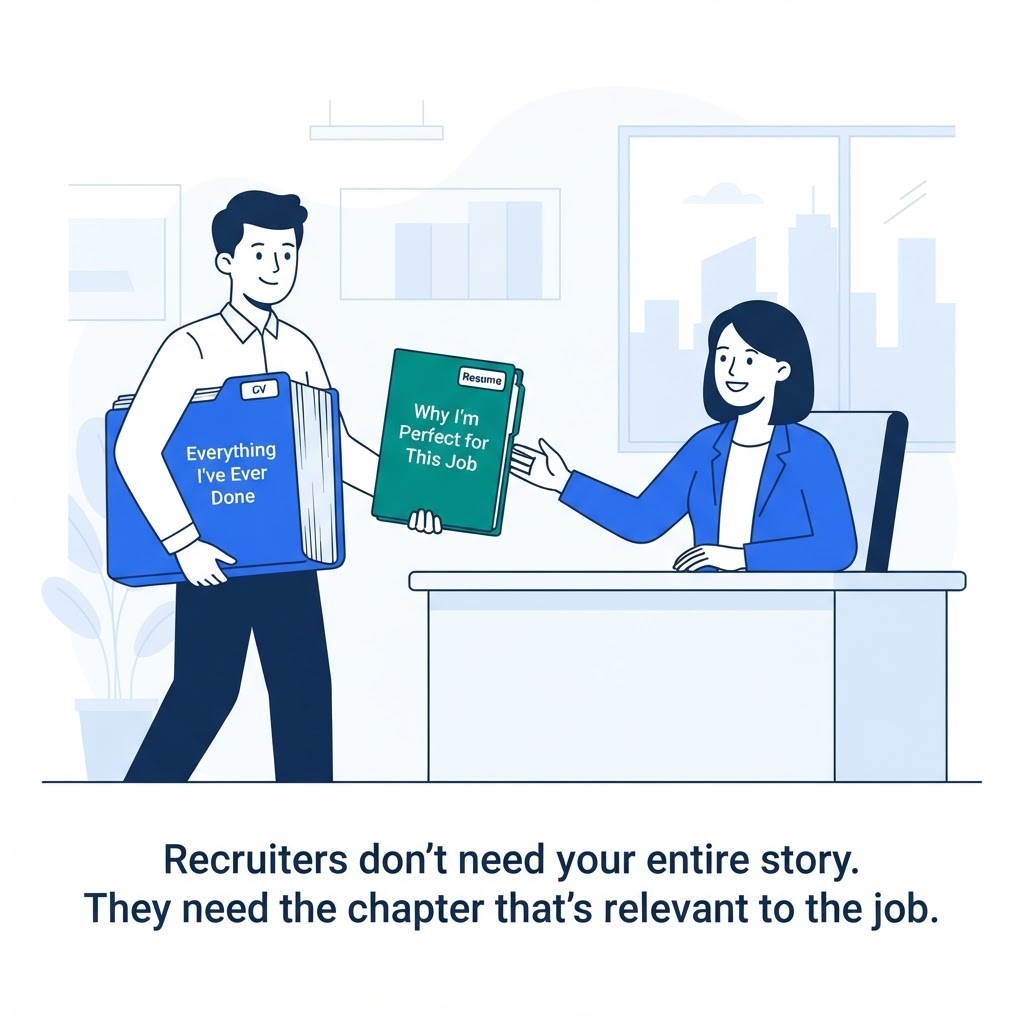
A resume is a concise, tailored document that highlights your skills and experience for a specific job. A CV (Curriculum Vitae) is a more detailed document that covers your complete academic and professional history. In most countries, employers asking for a resume expect a 1–2 page document. If they ask for a CV, check the country's hiring norms, as the meaning varies.
What You'll Learn
- •The key difference between a resume and a CV
- •When to use a resume vs a CV based on your country and industry
- •Why sending a long CV for a corporate job is a mistake
- •How length and purpose differ between the two documents
- •Why tailoring matters more than listing everything you've done
- •How to choose the right document for your next application
Why It Matters
One of the most common mistakes job seekers make is assuming a resume and a CV are exactly the same.
In countries like the United States and Canada, they are different:
- Resume → Tailored for each job application
- CV → Detailed record, mainly used in academia, research, medicine, and higher education
However, in countries like the UK, Ireland, Australia, New Zealand, and India, employers often use the term CV when they simply mean a resume.
The safest approach? Read the job description carefully and understand what's expected in that region. For a deeper dive, read why recruiters reject generic resumes.
Common Mistakes
- ❌ Sending a 6-page academic CV for a corporate job
- ❌ Using the same resume for every application
- ❌ Including every job you've ever had, even if it's irrelevant
- ❌ Assuming "Resume" and "CV" always mean the same thing worldwide
📊 Quick Comparison
Resume:
- Tailored for each job
- Usually 1–2 pages
- Focuses on relevant skills and achievements
- Common in corporate hiring
CV:
- Complete career history
- Can be several pages
- Includes education, publications, certifications, research and more
- Common in academia, research and medical fields
💡 CVDraft Tip
If you're applying for corporate jobs, think quality over quantity.
Recruiters aren't interested in everything you've done — they're interested in what makes you the right person for this role.
Tailor your resume for each application by highlighting the experience and achievements that best match the job description.
🎯 Hiring Language Perspective™
A resume tells recruiters, "Here's why I'm the right fit for this role."
A CV tells them, "Here's everything I've done throughout my career."
The best document isn't the longest one. It's the one that answers the employer's question fastest.
Resume vs CV at a Glance
Purpose:
- Resume: Get a specific job
- CV: Document your complete career
Length:
- Resume: 1–2 pages
- CV: No fixed limit
Tailored?
- Resume: ✅ Yes
- CV: ❌ Usually No
Best For:
- Resume: Corporate jobs
- CV: Academic & research roles
🔗 Related Quick Bites
- QB-001: What Is an ATS Score?
- QB-003: How Many Pages Should a Resume Be?
- QB-004: Can ATS Read PDF Resumes?
- QB-005: What Are Resume Keywords?
- QB-006: Should Every Resume Be Customized?
"Recruiters don't need your entire story. They need the chapter that's relevant to the job."
Recruiter's Advice
"Recruiters don't need your entire story. They need the chapter that's relevant to the job."
Key Takeaways
- A resume is concise and tailored; a CV is detailed and comprehensive
- In the US and Canada, resume and CV mean different things
- In the UK, Ireland, Australia, NZ, and India, 'CV' often means resume
- Resumes should be 1–2 pages; CVs have no fixed length
- Always read the job description to understand what's expected
- Tailor your document to the role — quality over quantity
Frequently Asked Questions
Build a Resume That Wins the 6-Second Test
AI writes the bullet points — you fill in the details. Get a clean, ATS-friendly resume in minutes.
Build My ResumePut This Into Practice
Analyze My Resume
Compare your resume against a real job description and identify ATS keyword gaps.
Go to Resume AnalyzerGenerate My Cover Letter
Create a tailored cover letter that matches your resume and target role.
Go to Cover Letter GeneratorContinue Your Journey
You have completed
✔ ⚡ Quick Bites Chapter 2
Continue with
➡ ⚡ Quick Bites Chapter 3
How Many Pages Should a Resume Be?