Why Recruiters Reject Generic Resumes (And How to Tailor Yours to a Job Description)
A recruiting leader's perspective after reviewing thousands of resumes across technology, healthcare, pharmaceuticals, consulting, manufacturing, and corporate functions.
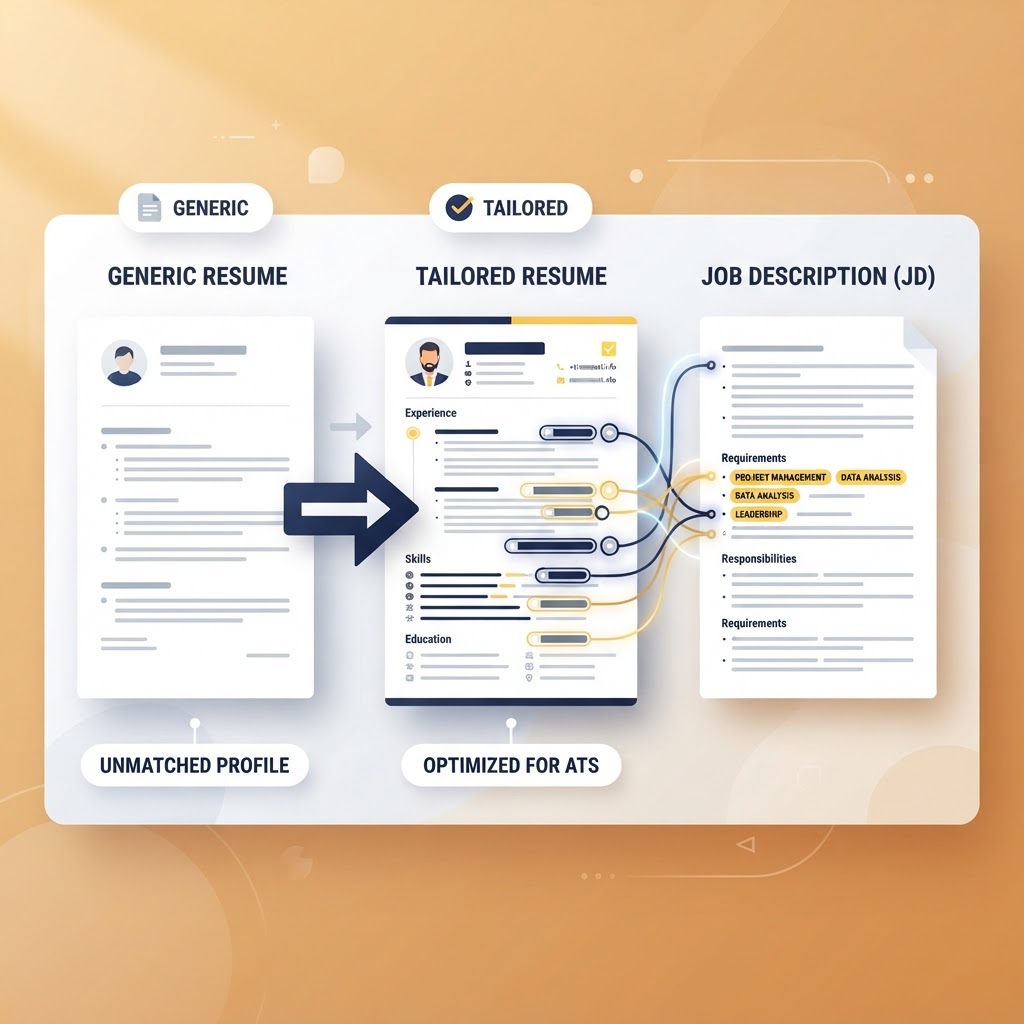
A few years ago, I was hiring for a senior operations role. Within three days, more than 400 applications landed in our ATS.
Most candidates assumed recruiters carefully reviewed every resume. We didn't. Not because we didn't want to. Because we couldn't.
When hundreds of resumes arrive for a single role, recruiters and hiring managers quickly look for evidence that a candidate understands the position they're applying for.
What surprised me most wasn't the lack of experience. It was the number of people who clearly had the right experience but presented it in a way that looked completely disconnected from the job description.
Strong candidates were rejected before they ever reached an interview. And almost all of them made the same mistake: they used the exact same resume for every application.
What You'll Learn
- •Why a generic resume gets rejected before a recruiter even reads it
- •How ATS systems actually filter and rank resumes
- •A 4-step framework for tailoring your resume to any job description
- •How to translate your experience into the employer's language
- •Common resume tailoring mistakes that cost you interviews
- •How AI tools can help you tailor resumes faster without fabricating experience
The biggest myth about resume writing
Many people believe a resume should be a complete summary of their career. That's not how recruiters use resumes. A resume is not your biography. A resume is a marketing document.
Its purpose is simple: convince a hiring manager that you are relevant to a specific role. Not every role. That role.
When recruiters review resumes, they are unconsciously asking one question: "Can I clearly see why this person is a fit for this position?" If the answer isn't obvious within the first few seconds, the resume loses momentum quickly.
What ATS Systems Actually Look For
There is a lot of misinformation online. Many job seekers imagine ATS software as a robot that automatically rejects resumes. That's not entirely true.
Most ATS platforms are primarily designed to organise applications, search candidates, and help recruiters filter large applicant pools. However, they do rely heavily on keywords and matching signals.
If a job description repeatedly mentions Program Management, Stakeholder Management, Risk Assessment, and Change Management — but your resume talks only about Coordinating projects, Supporting teams, and Managing schedules — the ATS may not immediately connect the dots.
A recruiter probably will. But first, your resume needs to reach that recruiter. That's where tailoring becomes important.
Step 1: Read the Job Description Like a Recruiter
Most applicants scan job descriptions. Recruiters study them. Before updating your resume, identify three things:
Core Responsibilities
What will this person actually spend most of their time doing?
Required Skills
Which skills appear repeatedly? Repeated language matters.
Business Outcomes
What problem is the company trying to solve by hiring this role?
Understanding these three areas changes how you position yourself.
Step 2: Find the Language the Employer Uses
Words matter. Not because recruiters are obsessed with buzzwords. Because language signals alignment. Consider these examples:
Job description says
Data Analysis
Project Management
Process Improvement
Stakeholder Management
Your resume says
Reporting Activities
Team Coordination
Operational Support
Cross-functional Communication
The experiences may be similar. But one version matches the employer's language. And matching language improves both ATS visibility and recruiter confidence.
Step 3: Connect Your Experience to Their Needs
This is where most resumes fail. Candidates describe what they did. Strong candidates explain why it mattered.
Instead of: 'Responsible for inventory management.' Try: 'Managed inventory processes that reduced stock shortages by 18% and improved order fulfilment accuracy.'
Recruiters notice impact. Results create credibility. Numbers create trust.
Step 4: Optimise for ATS Without Writing for Robots
A common mistake is stuffing resumes with keywords. Recruiters spot this immediately.
A good resume should read naturally while incorporating relevant terminology from the job description.
Think of it this way: you're writing for two audiences — the ATS and the human reviewer. Your resume must satisfy both.
Quick Checkpoint
A Pattern I've Seen Repeatedly
After reviewing thousands of resumes, one pattern stands out. Candidates often underestimate how differently companies describe similar work.
A project coordinator at one company may perform nearly identical work to a programme manager at another. The responsibilities are similar. The language is different. And language influences visibility.
This is why tailoring is often less about changing your experience and more about translating it into language that aligns with the employer's expectations.
Using AI to Tailor a Resume Faster
This is where modern AI tools can save enormous amounts of time. Instead of manually comparing every bullet point against a job description, AI can identify missing keywords, skill gaps, ATS alignment opportunities, weak resume sections, and opportunities to strengthen impact statements.
Tools like CVDraft help job seekers compare their resume against a job description, identify keyword gaps, optimise ATS alignment, and generate tailored resume content in minutes.
The goal isn't to replace your experience. The goal is to present it more effectively.
Common Resume Tailoring Mistakes
- Applying with the same resume everywhere — every job description emphasises different priorities
- Copying the job description word-for-word — recruiters recognise this instantly
- Ignoring measurable results — impact matters more than responsibilities
- Overusing keywords — keyword stuffing hurts credibility
- Focusing only on ATS — remember that a human eventually reads the resume
Final Thoughts
Here's what twenty years of hiring has taught me: most rejected candidates aren't rejected because they lack capability. They're rejected because their resumes fail to communicate relevance.
The strongest applicants don't necessarily have the most experience. They make it easiest for recruiters to see the connection between their experience and the role. A tailored resume does exactly that.
Before submitting your next application, ask yourself one question: if a recruiter spends only ten seconds on my resume, will they immediately understand why I'm a fit for this job? If the answer is unclear, don't send the application yet. Tailor first. Apply second.
"A tailored resume doesn't change who you are. It makes it impossible for a recruiter to miss why you're right for the role."
Recruiter's Advice
"A tailored resume doesn't change who you are. It makes it impossible for a recruiter to miss why you're right for the role."
Key Takeaways
- A resume is a marketing document, not a biography — position it for one role at a time
- Read the job description like a recruiter: identify core responsibilities, required skills, and business outcomes
- Mirror the employer's language — 'Data Analysis' beats 'Reporting Activities'
- Connect your experience to their needs with quantified impact statements
- Avoid keyword stuffing — write naturally while incorporating relevant terminology
- Use AI tools to identify keyword gaps and optimise ATS alignment in minutes
Frequently Asked Questions
Test Your Resume Against a Real Job Description
Upload your resume and paste a job description — get an instant ATS match score, keyword gaps, and actionable fixes.
Analyze My ResumePut This Into Practice
Analyze My Resume
Compare your resume against a real job description and identify ATS keyword gaps.
Go to Resume AnalyzerGenerate My Cover Letter
Create a tailored cover letter that matches your resume and target role.
Go to Cover Letter GeneratorContinue Your Journey
You have completed
✔ 📕 Recruiter's Notebook Chapter 1
Continue with
➡ 📕 Recruiter's Notebook Chapter 2
What Recruiters Don't Say When They Give You Feedback
Original Concepts Notice
This publication contains original concepts, frameworks, terminology, and educational models developed as part of The CVDraft Framework™.
Names such as The Authenticity Ceiling™ and other CVDraft Framework™ concepts are original CVDraft brand terminology and should always be presented consistently.
© CVDraft. All Rights Reserved.