What Is the Best Resume Format?
The best resume format isn't the most creative — it's the one recruiters understand the fastest.
The best resume format is the one that showcases your most relevant experience clearly and makes it easy for recruiters to understand your career story. For most job seekers, a reverse chronological resume is the best choice because it's the format recruiters expect and ATS systems can easily read. Choosing the right format isn't about making your resume look different — it's about making it easier to understand.
What You'll Learn
- •Which resume format is best for most job seekers
- •The difference between reverse chronological, functional, and hybrid formats
- •Why recruiters prefer familiar, well-structured formats
- •When a functional or hybrid resume is the right choice
- •Common formatting mistakes that hurt your chances
- •How to choose the format that best supports your career story
✅ Short Answer
The best resume format is the one that showcases your most relevant experience clearly and makes it easy for recruiters to understand your career story.
For most job seekers, a Reverse Chronological Resume is the best choice because it's the format recruiters expect and ATS systems can easily read.
Why It Matters
Choosing the right resume format isn't about making your resume look different—it's about making it easier to understand.
Recruiters often spend only a few seconds on an initial review. A familiar, well-structured format helps them quickly find what they're looking for.
There are three common resume formats:
Reverse Chronological
Lists your most recent experience first.
✅ Best for most professionals.
Functional (Skills-Based)
Focuses on skills instead of work history.
⚠️ Often not preferred because recruiters want to see where and when you gained those skills.
Combination (Hybrid)
Blends skills with chronological experience.
✅ Useful for professionals changing careers or those with specialized expertise.
For most applicants, Reverse Chronological remains the safest and most effective choice.
Common Mistakes
- ❌ Choosing a fancy template over readability
- ❌ Hiding employment history in a skills-based resume
- ❌ Using multiple columns, graphics, or complex layouts that confuse ATS
- ❌ Prioritizing design over content
📊 Quick Comparison
| Resume Format | Best For |
- Reverse Chronological → Most professionals and corporate roles ✅
- Functional (Skills-Based) → Limited situations such as significant career gaps ⚠️
- Combination (Hybrid) → Career changers and specialized professionals ✅
💡 CVDraft Tip
Don't choose a format because it looks impressive.
Choose the format that helps a recruiter answer these three questions quickly:
- What have you done?
- Where did you do it?
- How well did you do it?
If your resume answers those questions within seconds, you're using the right format.
🎯 Hiring Language Perspective™
Recruiters don't hire creativity in resume layouts.
They hire clarity.
A beautifully designed resume that hides important information is less effective than a simple resume that clearly demonstrates your value.
Your format should support your story—not compete with it.
📊 Which Resume Format Should You Choose?
Start Here
- Do you have consistent work experience?
- YES → Reverse Chronological → Best Choice
- NO → Career Change or Gap?
- YES → Consider Hybrid Format
For most professionals, reverse chronological is the safest, most effective format.
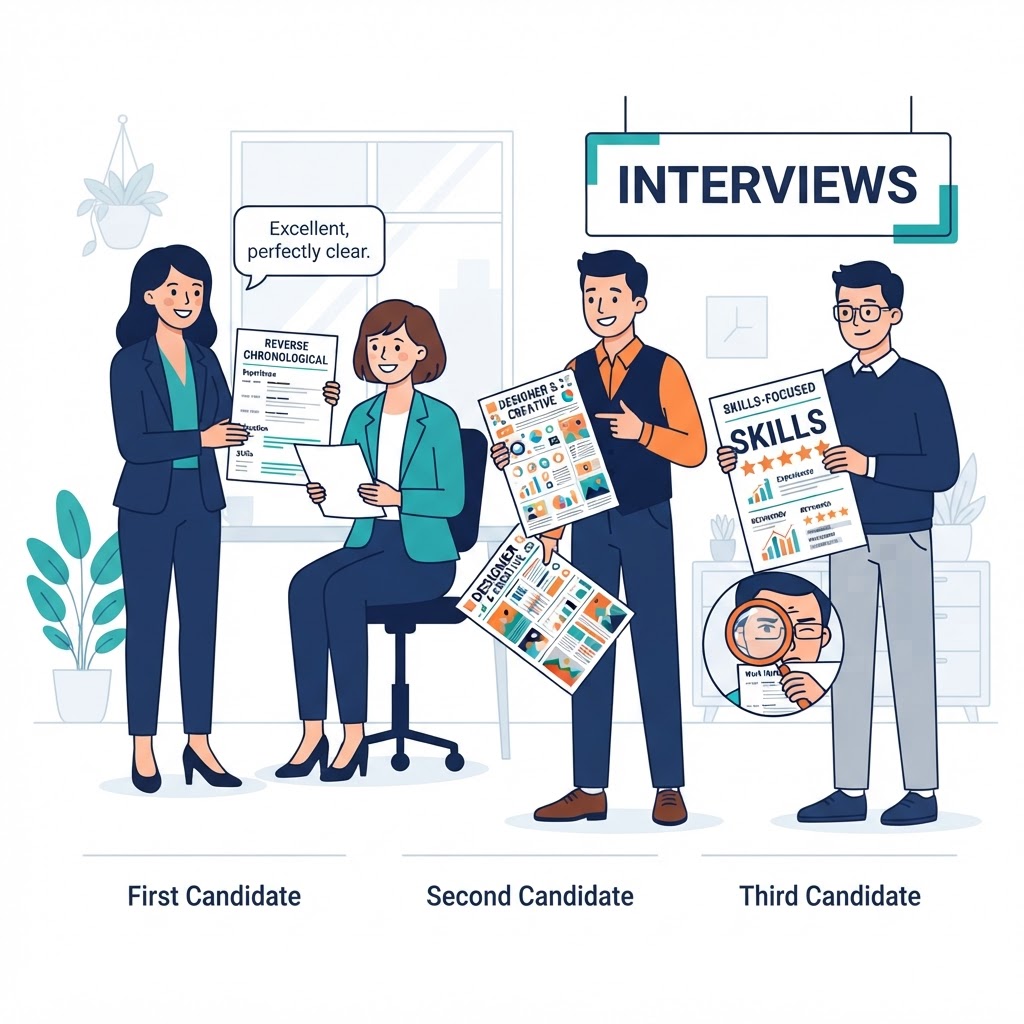
🎨 The Three Candidates (A Quick Visual)
Imagine three candidates arrive for an interview:
- The first hands over a simple, neatly organized Reverse Chronological resume — the recruiter smiles and starts reading immediately
- The second presents a flashy resume filled with icons, graphics, and multiple columns — the recruiter turns it sideways, looking confused
- The third hands over a resume where all the work history is hidden behind a giant "Skills" section — the recruiter searches with a magnifying glass
The easier your resume is to read, the easier it is to remember.
🔗 Related Quick Bites
- QB-002: Resume vs CV: What's the Difference?
- QB-003: How Many Pages Should a Resume Be?
- QB-004: Can ATS Read PDF Resumes?
- QB-005: What Are Resume Keywords?
- QB-006: Should Every Resume Be Customized?
"The best resume format isn't the most creative—it's the one recruiters understand the fastest."
Recruiter's Advice
"The easier your resume is to read, the easier it is to remember."
Key Takeaways
- The best format showcases your most relevant experience clearly
- Reverse chronological is the safest and most recruiter-friendly choice for most professionals
- Functional resumes often raise questions because they hide where and when you gained skills
- A hybrid format works for career changers and specialized professionals
- Never prioritize design over readability or ATS compatibility
- Choose the format that answers what, where, and how well — within seconds
Frequently Asked Questions
Build a Resume That Wins the 6-Second Test
AI writes the bullet points — you fill in the details. Get a clean, ATS-friendly resume in minutes.
Build My ResumePut This Into Practice
Analyze My Resume
Compare your resume against a real job description and identify ATS keyword gaps.
Go to Resume AnalyzerGenerate My Cover Letter
Create a tailored cover letter that matches your resume and target role.
Go to Cover Letter GeneratorContinue Your Journey
You have completed
✔ ⚡ Quick Bites Chapter 12
Continue with
➡ ⚡ Quick Bites Chapter 13
Should I Write a Resume Objective or a Professional Summary?